Op het you-tube kanaal van +Ramón Bilbao #Rioja verschijnen met grote regelmaat video over hun wijnen, Dit maal de Rosado waarbij een aantal mooie spijscombinaties worden getoond. Geluid is in het spaans, gelukkig is dit mooi ondertiteld in het engels.
Waar te koop: In Nederland importeert @Verbunt Wijnkopers dit #rioja wijnhuis voor de +Wijnkring en #Horeca.
Posts tonen met het label whyn. Alle posts tonen
Posts tonen met het label whyn. Alle posts tonen
zondag 22 januari 2017


zaterdag 21 januari 2017
Marchesi Di Barolo Zagara
The Fifty Best awardes the Moscato D'Asti Zagara of @Marchesi di Barolo with a GOLD medal in the category of dessert wines.

The wines of Marchesi di Barolo are imported for the Netherlands by @Verbunt Wijnkopers and sold via +Wijnkring and #ontrade.
More info: please check the websites www.verbunt.nl or www.wijnkring.nl
vrijdag 20 januari 2017
Domaine Cazes Hommage
La cuvée Hommage sélectionnée à la 8e du classement Decanter :
"75 Stellar buys of 2016 The most exciting wines we’ve tasted this year"
The wines of Domaine Cazes are imported by @Verbunt Wijnkopers for the Netherlands and sold via @Wijnkring and #ontrade
More info: www.verbunt.nl or www.wijnkring.nl
donderdag 19 januari 2017
Yalumba news
Some Yalumba News:
James Halliday Wine Companion Australian Cabernet Challenge 2016
 |
| The Cigar, coming soon to Europe |
 |
| The Menzies |

GOLD, GOLD, GOLD! Yalumba The Menzies Cabernet Sauvignon 2013,Yalumba The Cigar Cabernet Sauvignon 2013 won gold medals at the Halliday Wine Companion Australian Cabernet Challenge. Congratulations Peter Gambetta, Natalie Cleghorn and our vini and viti teams.
Jansz Tasmania Premium Cuvée
Jansz Tasmania Premium Cuvée is #1 in
Elin Clarke's '50 best wines under $70 to buy in 2017'Jansz Tasmania Premium Cuvée is #1 in

Ads for the DS Serie Paradox, The Signature and Octavius

+Yalumba is imported by @Verbunt Wijnkopers and sold via +Wijnkring and #Ontrade.
woensdag 18 januari 2017


maandag 5 december 2016
Jefford on Monday: The taste of Cava
Jefford on Monday: The taste
of Cava
Andrew Jefford
considers the role of indigenous grape varieties in Cava and other sparkling
wines.

Recaredo's
Xarel-lo grapes. Credit: Andrew Jefford
The taste of Cava is
important. It matters, indeed, even to those who never drink sparkling
wine. If this sounds bizarre, bear with me.
Champagne – no
surprise here — is the dominant force in sparkling wine. More than that:
it’s one of humanity’s happiest achievements, like the invention of the piano
or the bicycle. Take a flock of low chalky hills in the dour,
agri-industrial landscape of northern France, plant three members of the Pinot
family, harvest them just before winter slams the door on summer, then
manipulate the results with cunning craftsmanship. The result is the most
famous wine in the world, and a symbol and metaphor for celebratory ease and
sensual finesse.
Within the wine
world, Champagne’s dominance of its category means that there is an
almost-unquestioned assumption that all sparkling wine should be made in that
way, and from those varieties. It’s wise to assume the former. The
latter, I’d suggest, is often an error.
Chardonnay and
the two Pinots make impeccable sparkling wine in the Champagne region, where
they can snail towards ripeness over a cool, fretful summer. In sugar
terms, they don’t fully ripen– but the Champagne method, and a little
chaptalisation if necessary, compensates for that. Phenolically, by
contrast, the long season gives these varieties a perfumed, vinous, nuanced and
teased ripeness which makes Champagne sing. (Climate change gives the
nearby UK a plausible stab at pulling off the same trick.)
Once you start
to shift the varieties towards lower latitudes, by contrast, those varieties
begin to lose their interest. No grape variety, remember, is universally
great. They are only great in a certain place on earth, with all that
that means in terms of soil, topography and climate. Champagne’s hegemony
has been wonderful for Champagne, but it may have held other sparkling wine
producers around the world in check.
It’s true that
in very cool places (Tasmania comes to mind), Chardonnay and the Pinots may
indeed be the best choice pending the revelation of better options, for which
experiment is needed. In warmer locations, though, Chardonnay and the
Pinots are often a poor choice. In order to give a sparkling wine
something resembling ‘a Champagne balance’, the varieties have to be picked
inarticulately early, long before they have achieved any kind of phenolic
maturity; and in such locations, when phenolic maturity eventually comes, it
will be much less subtly constituted than in Champagne anyway. An
alternative (and often a complement) is for producers to adjust acidity,
thereby making an industrial product whose fine-wine interest drops swiftly
away.
‘The best Cava is a fine
sparkling wine of genuinely indigenous style’
Take a look at
the varietal nuancing which unfolds during a sparkling journey south from
Champagne towards Cava. We clip through the Loire valley, where the
climate and soils are still close enough to those of Champagne for
Chardonnay-Pinot sparklers to work well, even if Chenin Blanc creates more
interesting and regionally characterful sparkling wines. Chardonnay and
Pinot Noir can make Crémant de Bourgogne a plausible Champagne substitute
(remember Chablis’s close proximity to the Champagne’s Aube region), though
Chardonnay begins to assert its still-wine varietal character once you are
south of the Yonne, and especially so if the raw materials come from southern
Burgundy or Beaujolais. (I plan to take a close look at Crémant de
Bourgogne in 2017.)
By the time we
reach Limoux in the cool upper Aude valley, the rules regarding grape varieties
for sparkling wine are in sensible modulation, reflecting latitude. Yes,
you can use Chardonnay and Pinot Noir, but there is little chance down here of
phenolic ripeness outrunning sugar ripeness and delivering a full-season
Chardonnay or Pinot grape with a potential alcohol of just 9.5% or 10%.
Most Crémant de Limoux is in fact principally a blend of Chardonnay and Chenin,
while the more interesting Blanquette de Limoux is based on the perfectly
site-adapted local variety Mauzac. The result is a set of often refined
sparkling wines which do not unsuccessfully ape Champagne, but reflect their
surroundings.
Press on over
the Pyrenees and down the Mediterranean coast to Catalunya, and for the first
and only time in the wine world you will come across a major sparkling wine
region using the ‘traditional method’ whose very greatest wines do not include
Chardonnay or either of the red Pinots, but are crafted from the indigenous
varieties Macabeo, Xarel-lo and Parellada. (Prosecco, too, is based on
its own indigenous variety Glera — but most is made by the Charmat method,
known in Italy as Metodo Martinotti.)

Limestone
pebbles typical of the Cava region. Credit: Gramona
The result, in
the case of the best Cava, is a fine sparkling wine of genuinely indigenous
style. One which, in other words, not only has Mediterranean scents and
flavours, but whose balance is necessarily and appropriately different to that
of Champagne.
The taste of
Cava matters, then, not only because the finest examples are beautiful in their
own right (see the tasting notes below), but because it could and should serve
as a model for sparkling wine produced in lower latitudes and warmer
locations. Take away the bubbles, and it illustrates one of the
fundamental truths of terroir: the necessity to be honest about exactly which
varieties are well adapted to a site, and the duty to work with those if you
want to make wine which can give fullest voice to the potential of a place.
Of course you
can make a counter-argument based on the commercial desirability of sparkling
wines based on the Champagne formula. Moreover because technique and
craft plays a larger role in the creation of sparkling wine than of still wine,
skilled practitioners can do “a decent job” with Chardonnay and Pinot Noir
almost anywhere, not least in Catalunya itself. The result, though, will
always be some sort of a compromise — and at the highest levels, that’s not
enough.
Describing Cava
Fine Cava is
customarily un-dosed (though one of the four Cavas below has 6 g/l) and is
intrinsically well-balanced in that state. The acid profile is gentler
than for Champagne, though the indigenous varieties are still picked relatively
early; its factors of balance are texture and aroma rather than acidity
alone. The spectrum of aromas and flavours is unique, Mediterranean in
inspiration and allusion, and quite different from those of Champagne.
Source: http://www.decanter.com/wine-news/opinion/jefford-on-monday/taste-cava-sparkling-wine-348716/
zondag 20 november 2016
Pol Roger Champagne scores big
The famous Pol Roger Champagne of Epernay scores big in several international tastings.
In its 160 years of history, Pol Roger has carved out one of the most flattering reputations in the select circle of the leading Champagne brands.
This years scores proof the quality:


In the Netherlands +Champagne Pol Roger is imported by +Verbunt Wijnkopers and sold via +Wijnkring, @whyn shop, on-trade and www.polrogershop.nl
dinsdag 2 augustus 2016
California Chardonnay
KENDALL-JACKSON
These wines
were tasted for the California Chardonnay alphabetical listing report in the
July 31, 2016, issue of Wine Spectator magazine.

http://www.kj.com/jackson-estate-camelot-highlands-chardonnay
See for your salesadress nearby: www.wijnkring.nl

maandag 1 augustus 2016
Salentein scores at Tim Atkins tasting

Tim Atkin
This is my third report on Argentina’s vibrant wine industry and it's the longest and most comprehensive overview of the country I've published to date, running to more than 90 pages. I’ve never been afraid to speak my mind and this report is no exception. It’s an informed, in-depth overview based on more than 20 years of visits to Argentina, including a two-week trip at the end of 2014, and a lot of tastings. There are exciting new discoveries, as well some internationally famous wines reviewed here. And, for the first time, I have published a classification of Argentina's top 120 wineries.About TIM ATKIN
I’m an award-winning wine writer and Master of Wine with 28 years’ experience.I write for a number of publications, including The World of Fine Wine, Intelligent Life, Gourmet Traveller Wine, Imbibe, Decanter, Wine-searcher, Fine Drink (China)
and Woman and Home, appear regularly on BBC1’s Saturday Kitchen and am one of the Three Wine Men. I am a co-chairman of the International Wine Challenge,
the world’s most rigorously judged blind tasting competition, and have won over 25 awards for my journalism and photography.
A personal selection of Argentina’s best wines
Scores & Tasting Notes


94 Points - 2012 Salentein Single Vineyard Chardonnay, Plot No. 2 - 13.5% Uco Valley
Salentein’s grapes come from one of its highest Uco Valley vineyards, located at 1,600 metres in San Pablo.The wine goes through malolactic fermentation but doesn’t seem fat in the slightest, thanks to the freshness
and bite of its cool site. Smoky, mealy and very elegant with a tangy finish. Drink: 2015-19

94 Points - 2011 Salentein Gran Vu - 15% Uco Valley
This was only Pepe Galante’s second vintage at Salentein, but his experience and talent werealready apparent in this blend of Malbec and Cabernet Sauvignon. Densely coloured and still
youthful, with flavours of dried herbs, cassis and blackberry, a hint of graphite, sweet oak
and the concentration to age. Drink: 2015-22

94 Points - 2012 Salentein Numina
Cabernet Franc- 14.5% Uco Valley
This was very good in 2011, but is even better in 2012. It’s the perfume that strikes you first -grassy, scented and very alluring - but the palate is lovely, too: elegant, refined, deftly oaked
and silky. Yet more evidence that Cabernet Franc can be a very special variety in the Uco
Valley. Drink: 2015-20

94 Points - 2012 Salentein Numina Gran Corte -
14.5% Uco Valley
Salentein’s top red blend combines Malbec with lesser amounts of Cabernet Sauvignon,Merlot, Cabernet Franc and Petit Verdot and is very impressive indeed, showing polished
tannins, power, pepper, subtle oak, chalky acidity and a long, tapering finish. A wine to watch. Drink: 2015-22

94 Points - 2011 Salentein Single Vineyard Malbec,
Plot No. 21 - 14.5% Uco Valley
This ungrafted Malbec was planted at 1300 metres in 1997 on some of the poorest soils on theestate. It’s yet another beautifully framed red from Pepe Galante with stylish oak, a sturdy
backbone of tannin, some Mediterranean spices and a fresh, chalky bite. Drink: 2015-20

94 Points - 2013 Salentein Single Vineyard Pinot Noir, Plot No. 1 - 13.5% Uco Valley
Made with an Italian Pinot Noir clone planted in San Pablo at 1,400 metres, this is a lightlyoaked, partial whole bunch fermented red with sweet red cherry and raspberry fruit, bright,
chalky acidity and a long finish. Very promising. Drink: 2015-19

93 Points - 2012 Salentein Primus
Cabernet Sauvignon 14.5% Uco Valley
The first vintage of Cabernet under the Primus label, this is made from clones 337 and 169
As such, it’s one of only a handful of top examples in Argentina. Stylish, firm and structured with an enticing balance between fruit purity, tannins and acidity. A label to watch.

Drink: 2015-20
93 Points - 2011 Salentein Primus Malbec 14% Uco Valley
Primus comes from three small plots located between 1,100 and 1,300 metres. The result is mineral, spicy and focused, showing its cool climate origins. The oak is more pronounced herewith some mocha notes, but there’s plenty of structure and fruit weight, too. Drink: 2015-20
93 Points - 2012 Salentein Primus
Chardonnay 14% Uco Valley
Primus is priced above the Plot 2 Chardonnay, but is not necessarily better in 2012, just richer. This is another very stylish bottling from a winery that is gaining in reputation. Complex, mealy and toasty with bright minerality and some texture from partial malolactic fermentation. Drink: 2015-19
 93 Points - 2012 Salentein Numina Syrah 14.5% Uco Valley
A comparatively rare example of a top notch Syrah in Argentina, this is made from a single clone planted in 1996. Spicy, peppery and polished, like most ofthe Salentein wines, it’s closer to the Rhône than the Barossa Valley in style.Smoky, spicy and impressively complex. Drink: 2015-20

92 Points - 2012 Salentein Primus Pinot Noir 13.5% Uco Valley
This comes from a slightly lower vineyard than the Plot 1 and is made from a mixture of Burgundian clones. It’s a littlefirmer and drier than the single vineyard releases, showing a little more oak as well, but is another classy Pinot.
Drink: 2015-18
 |
| Chief winemaker José "Pepe" Galante |
zondag 31 juli 2016
Ogier Caves des Papes (1)
In juni bezocht ik samen met een groep enthousiaste @Wijnkring ondernemers het wijnhuis @Ogier Caves des Papes in +CHATEAUNEUF DU PAPE In dit verslag alles over het topdomein Clos de L'Oretoire des Papes.
 De ondernemers die mee reisden naar dit prachtige wijnhuis hadden in het voorjaar van 2016 een actiepakket gekocht bij +Verbunt Wijnkopers. Na loting werd de groep vastgesteld.
Ogier stamt uit 1859 en is destijds gesticht door een Deen genaamd Ogier. Deze krijger had gevochten in het Baskenland en reisde op de terugweg naar Denemarken door het centraal massief. Denemarken heeft hij nooit meer bezocht. De Rhone streek werd zijn nieuwe stek.
Even buiten het plaatsje Chateauneuf du Pape is Clos de L'Oretoire des Papes gelegen.

Clos de L'Oretoire des Papes
Een bezoek aan de wijngaarden kan natuurlijk niet zonder proeven. Van Clos de L'Oretoire proefden wij:


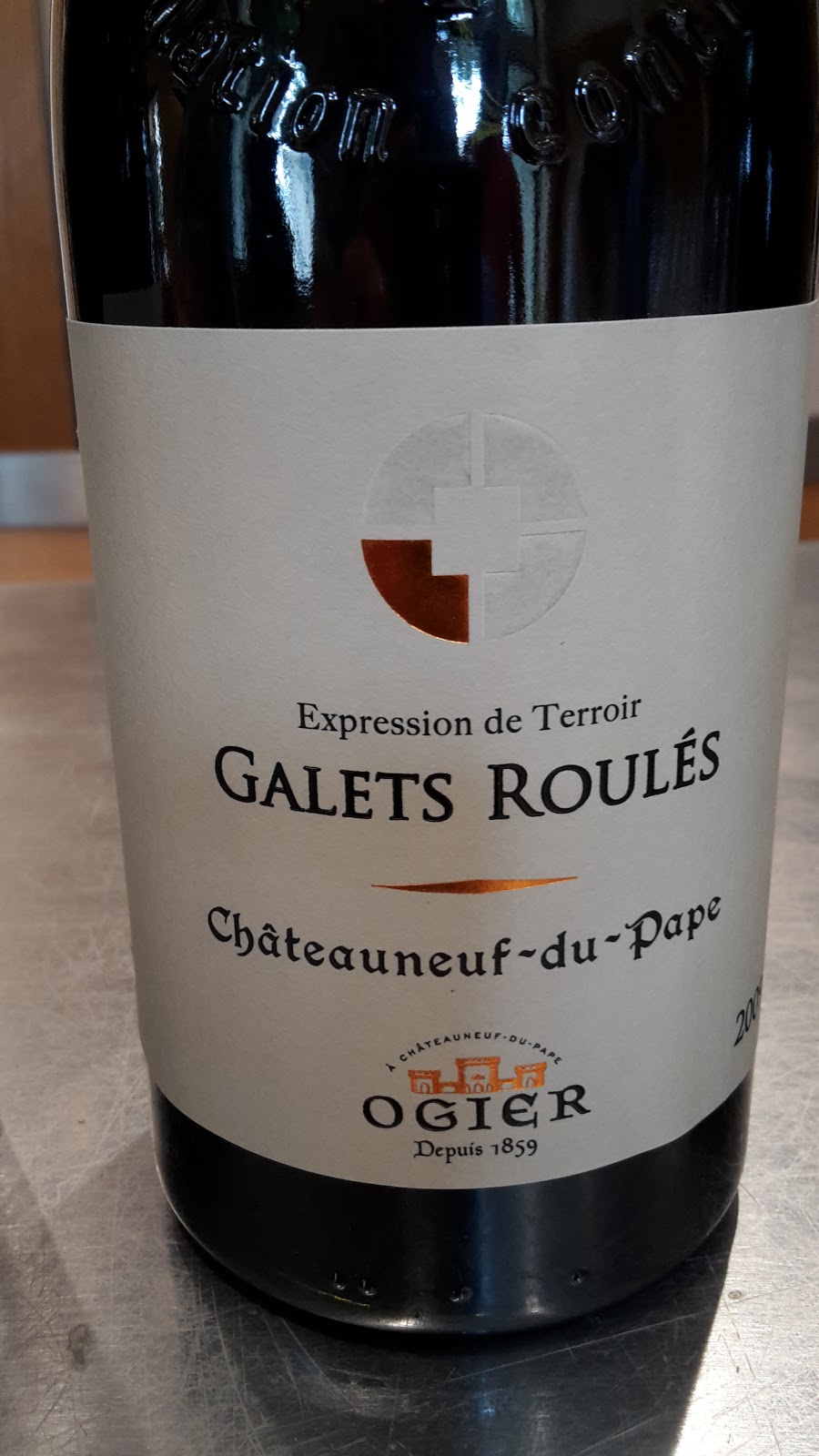
Vervolgens proefden wij de vier grote terroirs uit de regio om de expressie van ieder afzonderlijke terroir te herkennen. Chateauneuf due Pape is altijd een blend van deze terroirs.


Ogier stamt uit 1859 en is destijds gesticht door een Deen genaamd Ogier. Deze krijger had gevochten in het Baskenland en reisde op de terugweg naar Denemarken door het centraal massief. Denemarken heeft hij nooit meer bezocht. De Rhone streek werd zijn nieuwe stek.
Even buiten het plaatsje Chateauneuf du Pape is Clos de L'Oretoire des Papes gelegen.
 |
| Wijnmaker in de wijngaarden rondom Clos L'Oretoire de Papes |
 |
| Typisch Rhone terroir, |
 |
| Uitzicht op de "kale" berg Mont Ventoux. Op de voorgrond is een heringericht stuk natuur wat als waterreservoir voor de omgeving wordt gebruikt. Vele inheemse insecten en vogels zijn er weer terug. Voor de wijngaarden is dit van groot belang, er zijn nu minder tot geen bestrijdingsmiddelen meer nodig. |
 |
| Op de achtergrond het net gerenoveerde Clos L'Oretoire. Wij waren er de dag voor de officiele opening. Door alle bouwmaterialen konden we helaas (nog) geen goede foto's van de buitenzijde maken. |
 |
| De wijnmakerij, splinternieuw en voorzien van de modernste tools |

 |
| Kleinere vaten in de kelder, voorzien van warmte en koelelementen |
 |
| De pers waar alleen het fruit van dit Domein wordt geperst. |
 |
| Moderne betonnen "ei-vormige" fermentatie vaten voor met name de witte wijnen. |
Leunend tegen een van zijn percelen, is een klein oratorium
gewijd aan Sint Marc daterend uit de achttiende eeuw. Hij waakt over de
wijngaarden en is de oorsprong van de legendarische naam Clos de L'Oretoire des
Papes . In 1880, verwierf Edouard Amouroux een wijngaard met een bijzondere
tentoonstelling in de stad Châteauneuf - du - Pape .De legende was geboren ...
en sinds 1926 , wordt de fles nog steeds voorzien van hetzelfde label gecreëerd
door Amouroux familie . Le Clos des Papes Retorica is van een wijngaard van 25
hectare, een perfecte balans tussen de grote 4 terroirs van Châteauneuf du Pape.
 |
| Sint Marc "leunend" tegen de wijngaarden van Clos de L'Oretoire des Papes |
 |
Heerlijk frisse mineraal witte wijn.
Tonen van rijpe witte perzik. Zeer fraai en jong drinkbaar!
|
 |
| Jong in het glas, veel primair fruit, helder licht rode kleur. prachtige begeleider van lamsvlees. Nieuwe stijl! |


 |
| Donkerder, riiper dan de 2014. Meer de "oude" stijl Chateauneuf du Pape. |
Vervolgens proefden wij de vier grote terroirs uit de regio om de expressie van ieder afzonderlijke terroir te herkennen. Chateauneuf due Pape is altijd een blend van deze terroirs.

 |




Abonneren op:
Posts (Atom)